

It's Time for
Action
Reef Buddy Projects
Everything Reef Buddy does splits into two streams, running side by side in both Carriacou and Dauin: real science, and real hands-on restoration. You're never just observing the reef, and you're never just working on it blind. The two streams inform each other, in both locations, using the same standards.


STREAM 1: REAL SCIENCE
Reef Check & CoralWatch Monitoring
Long-term reef monitoring is the backbone of what we do. Using Reef Check and CoralWatch protocols. Internationally recognized, standardized methods. Volunteers collect data on coral health, fish populations, and invertebrate abundance at the same sites, at the same times, year after year.
That consistency matters. It's what lets us tell the difference between a bad week and a real trend. Early signs of bleaching or disease, not just seasonal noise. And because the data is collected to a global standard, what we record in Carriacou can be compared directly against what we record in Dauin, and against reef sites anywhere else in the world using the same protocols.
3D Photogrammetry
Beyond written surveys, volunteers help build detailed 3D models of live reef sections. A level of structural detail a clipboard survey alone can't capture. Over time, these models let us track exactly how a reef is changing: growth, damage, recovery, all mapped in three dimensions rather than estimated from memory.
Apex Predator Monitoring
Sharks, rays, and large predatory fish keep a reef ecosystem in balance — when their numbers drop, the effects ripple through everything beneath them. We track their presence using Baited Remote Underwater Video Surveillance (BRUVS), a non-intrusive method that records predator activity without a diver's presence disturbing it.
This data helps us understand not just what's on the reef, but what's missing — an early warning system for imbalance long before it's visible to the naked eye.


STREAM 2: HANDS-ON RESTORATION
Coral Nurseries & Outplanting
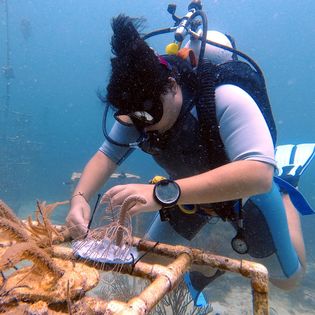
In both Carriacou and Dauin, we grow coral fragments in underwater nurseries before transplanting them onto damaged reef. It's slow, deliberate work. Fragmenting healthy coral, maintaining nursery lines, monitoring growth, and eventually out-planting mature pieces back where they're needed most.
In Carriacou, much of our focus and research is on growing and redeveloping soft coral beds. This is an area of coral conservation which is often overlooked as soft corals don't build structure like hard corals, but they do provide important habitats for marine life too.
In Dauin, we're working on 'direct to reef' structures. Building structures on damaged substrate and then out planting fragments directly. This reduces coral stress through the process, but does require more careful planning and maintenance
Volunteers are involved at every stage of that process, not just the final out-planting. You'll watch fragments you helped grow actually become part of a living reef. One of the few parts of this work where the impact is genuinely visible before you go home.
Population Control
Not every threat to a reef is a foreign invader. Sometimes it's a native species whose numbers have spiraled out of control because something further up the food chain is missing.
In Dauin, that means Crown-of-Thorns starfish and Drupella snails. Both natural parts of this reef system, but both prone to population explosions when their predators decline. Left unchecked, either can strip coral cover fast; right now, we're actually seeing more damage from Drupella than COTS, which is exactly the kind of shift ongoing monitoring is built to catch. Containment means organized, hands-on removal dives. Not eliminating the species, just controlling their numbers back down to where the reef can cope.
In Carriacou, the issue is different: lionfish, a genuinely invasive species with no natural predators in Caribbean waters. The problem isn't as severe as it was a decade ago, thanks to years of sustained removal efforts across the region. But we're still actively hunting and removing them from reproductively important reef sites, because letting the population rebound even briefly can undo years of progress.
Different coast, different cause, same principle: sometimes the most effective conservation work is knowing exactly what to remove, and why.
Same Standards, Two Coasts
Every one of these workstreams runs in both locations, using identical protocols. That's not a coincidence. It's what makes Reef Buddy's data genuinely useful beyond either individual site. A shrinking coral cover trend in the Caribbean and a resilience pattern in the Philippines only mean something next to each other if they were measured the same way.


Ready to be part of this?
How do we do this?
Each week has a focus. We rotate through four project areas on a four-week cycle, so every area gets equal time and attention, and you get real variety across your stay.
Monday starts on land with presentations on what we're doing, why it matters, and the science behind it. It's built for non-scientists, so no background is required. From there, you'll work through the practical skills you'll need before getting in the water.
Tuesday is in-water practice, learning exactly what to do and how, before it counts.
Wednesday through Saturday is the real thing. Three weeks focus on a single activity: reef surveys, 3D photogrammetry, or coral nursery work. The fourth combines two. Once the BRUVS are dropped and left to record undisturbed, that same week becomes population control, hunting Crown-of-Thorns, Drupella, or lionfish, depending on the coast.


Connect
Join us in protecting reefs worldwide
We can Call you
+63 969 579 8344
© 2026. All rights reserved.
Phone/Whatsapp